Ever since an emotional night in August when they won
the Copa Libertadores, South America's equivalent of the Champions
League, San Lorenzo have found it impossible to forget about the Club
World Cup.
They drifted through their domestic league,
closing the campaign with a morale boosting couple of wins to finish
eighth. But it was all build-up to now.
For them, as for any South American side, the
Club World Cup
is the highlight of their calendar. Many in other continents will
feel the same way. But no one in Europe will share the sentiment.
This imbalance is at the heart of the problems
faced by the Club World Cup, organised annually since 2005. The
competition replaced the annual match between the champions of Europe
and South America, a clash which got off to such a promising start.
The European Cup started in 1955. The
Libertadores got under way five years later, with the specific intent of
crowning a South American champion to take on the Europeans.

Pope Francis has been a loyal supporter of San Lorenzo since his childhood
The early ties were epic. By his own
reckoning, Pele's best ever performance came in the away leg against
Benfica in 1962, when he ran riot as his Santos side won 5-2. For the
first few years the games were gripping and intense, well-matched
affairs, with plenty of quality and the occasional dose of controversy.
But from the mid-60s things started to go
awry. Needing money to pay Pele and the rest, Santos pulled out of the
Libertadores, as, briefly, did all Brazilian clubs.
The field was left open for teams from
Argentina, at a time when, after the thrashing received at the 1958
World Cup, the romantic approach of the 1940s had given way to something
darker and more cynical.
Meanwhile, in Europe, ascendency had swung to the north,
starting with Celtic in 1967.
The cultural clash between northern Europeans and Argentines led to
a series of bruising encounters. The intercontinental clash lost
prestige, and some in Europe decided that the whole thing was not
worthwhile.
In 1980 the idea was resurrected as a one off
game in Japan, but though southern Europe paid more attention than the
north, the match never generated anything like the feverish importance
placed on it by the South Americans.
In recent times the imbalance has been
reinforced by the opening of the global market and the financial chasm
between European and South American football.
This, on the one hand, has increased European
indifference while, as far as the South Americans are concerned, adding
extra spice - this is their chance to put one over those rich,
glamorous, arrogant winners of the Champions League.
And there have been South American success -
single goal wins for three Brazilian clubs; Sao Paulo (2005),
Internacional (06) and
Corinthians two years ago.
In contrast with the days of old, though,
these South Americans took the field with a tactical approach that was a
confession of inferiority.
2014 Fifa Club World Cup fixtures & results:
|
Playoff round: 10 December - Moghreb Tetouan 0-0 Auckland City - (Auckland won 4-3 on penalties)
|
Quarter-finals: 13 December - Entente Setif 0-1 Auckland City
|
Quarter-finals: 13 December - Cruz Azul 3-1 Western Sydney Wanderers
|
Fifth-place match: 16 December - Entente Setif v Western Sydney Wanderers (16:30 GMT
|
Semi-finals: 16 December - Real Madrid v Cruz Azul (19:30 GMT)
|
Semi-finals: 17 December - San Lorenzo v Auckland City (19:30 GMT)
|
Third place match: 20 December - TBC - 16:30 GMT
|
Final: 20 December - at Marrakech, Morocco (19:30 GMT)
|
Outgunned, their aim was to sneak a goal and
grimly hang on. It was the best they could do in the financial
circumstances. Brazil's clubs might have much more money that their
continental rivals, but lag well behind the European giants.
This year the imbalance is even greater.
Completing a miserable year for the country's football, Brazil could not
even qualify one team for the semi-finals of the Libertadores.
Instead the trophy was won by San Lorenzo.
Average first division salaries and club income in Argentina are roughly
a third of those in Brazil - and less than 10% of those in the Premier
League or the big two in Spain.
Understandably, then, San Lorenzo are taking something of a pea-shooter army to do battle with Real Madrid.
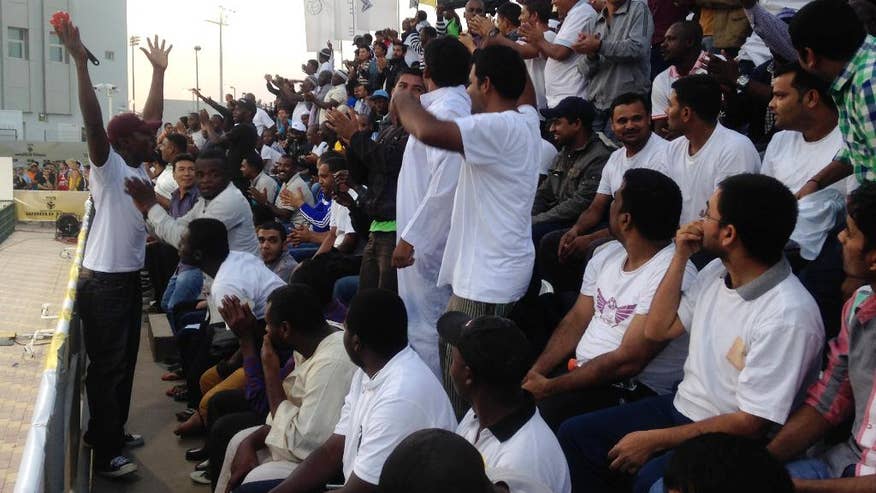
They will carry a sizeable contingent of fans
with him - some 5,000, including Hollywood actor Viggo Mortensen are
expected - but the Brazilian clubs, backed by a stronger currency, have
been able to take far more to recent versions of the competition.
San Lorenzo, though, will hope for some divine
intervention. Of the traditional Buenos Aires clubs they were the first
to suffer relegation and the last to get their hands on the
Libertadores. But things have looked up since their most illustrious
supporter,
Cardinal Bergoglio, became Pope Francis.
Just two years ago the club were very close to
another relegation. A change of president was important - Newcastle
fans might recall that Fabricio Coloccini was so taken with the new
administration that he tried to walk out of his contract and go back to
San Lorenzo.
And youthful president Matias Lammens (backed
by Marcelo Tinelli, a hugely famous TV presenter) had another piece of
help from on high.
The first signing of the new administration
came recommended by Diego Maradona - it was veteran central midfielder
Juan Mercier. With his sound reading of the game, improved distribution
and willingness to accept responsibility, Mercier was the most important
player in the entire Libertadores campaign.
This, though, speaks volumes about the limitations of a team preparing to take on Cristiano Ronaldo and company.

It has been a struggle for
San Lorenzo to keep key players including promising support striker
Angel Correa who joined Atletico Madrid in the summer
And the last few months have merely emphasised
the talent gap between the teams. Real Madrid have added a South
American superstar,
Colombia's World Cup success James Rodriguez.
San Lorenzo, meanwhile, were losing key players even as they were en route to winning the Libertadores.
Promising support striker Angel Correa went to
Atletico Madrid (delayed when a heart condition was discovered, the
move has recently been confirmed) and attacking midfielder Ignacio
Piatti joined Montreal Impact.
Centre-back Santiago Gentiletti has also moved
on, though Colombia's veteran World Cup captain Mario Yepes has come in
to replace him.
Buffarini and Mas are an interesting pair of
attacking full-backs, Mercier and Ortigoza are sound in central
midfield, while Gonzalo Veron and Barrientos (plus the speedy Villalba
off the bench) offer a threat down the flanks.
But coach Edgardo Bauza will surely be aware
that he can hardly hope to trade punches with Real Madrid. He was in
charge of LDU of Ecuador when they only lost by a single goal to
Manchester United in the final six years ago, and will presumably have a
similarly cautious strategy in mind.
First, though, he needs to get past Auckland
City in Wednesday's semi-final. The champions of Oceania have already
sprung a major surprise, eliminating Moroccan league winners Moghreb
Tetouan and African champions ES Setif from Algeria.
The New Zealanders have appeared in five
previous versions of this tournament, without previously hinting as this
level of performance.
The conclusion is clear - access to a higher
level of competition has taught them lessons, which have been
assimilated and applied. And that, for all the European lack of
interest, would seem to be a fair justification for the existence of the
Club World Cup.

 LONDON - Louis van Gaal has told his predecessor Alex Ferguson he
is still far from happy with Manchester United's performances despite an
impressive run that has catapulted them into the Premier League top
three.
LONDON - Louis van Gaal has told his predecessor Alex Ferguson he
is still far from happy with Manchester United's performances despite an
impressive run that has catapulted them into the Premier League top
three.